|
7/20 May 1897
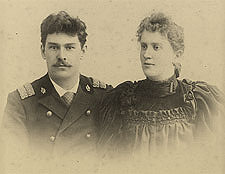
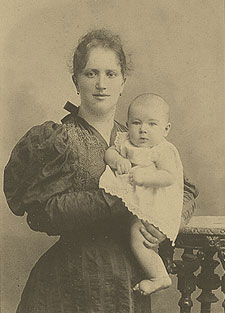
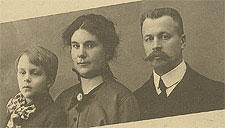
Born in Saratov to Alexander Nikolaevich Zagrekov (lawyer, graduate of Kazan University and doctor of jurisprudence) and Maria Petrovna Tokareva (descended from the nobility).
1904 – 1908
Studies at classical grammar school in Saratov.
1914 - 1918
Studies at the Bogolyubov School of Drawing in Saratov under Fyodor Korneyev, a colleague of many members of the “Saratov school” and the Blue Rose group of artists.
1916 - 1917
Studies at technical grammar school in Saratov, where special focus is placed on mathematical disciplines and artistic development.
1918 - 1921
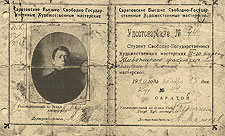
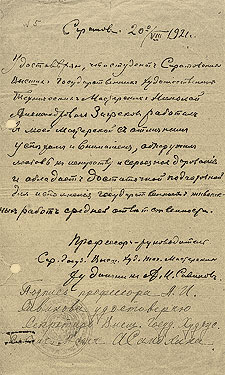
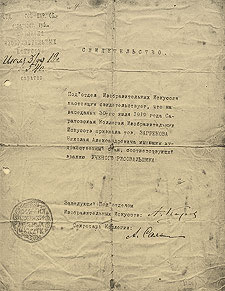
Studies under Alexei Karev and Alexander Savinov at the State Free Art Studios in Saratov.
9 April 1919
Marries Gertruda Galler. A student of the Bogolyubov School of Drawing, his wife comes from a family of Volga Germans.
1919 - 1921
Moves to Moscow and enrols at the VKhUTEMAS. Studies painting under Pyotr Konchalovsky and Ilya Mashkov. Simultaneously studies architecture. Studies drawing and painting in the studio of Dmitry Kardovsky.
December 1921
Leaves Moscow and moves with his wife to Riga, where her uncle, Peter Tokarev, lives. They decide to continue their art education in Berlin, where they are invited by Gertruda’s German relatives.
January 1922
Moves to Berlin with his wife. Rents a flat in the Charlottenburg district of Berlin, home to many Russian émigrés, including artists, writers and journalists.
October 1922
Enrols at the Gewerbeschule für Kunst und Handwerk in Berlin, where he studies under Professor Harold Bengen.
October 1925
At the urging of Harold Bengen, takes additional drawing lessons and soon becomes a member of staff.
1920s to early 1930s
Works prolifically and gives private lessons. Contributes to exhibitions in Berlin, Munich, Paris and Vienna and the shows of the Preussische Akademie der Künste, Munich and Berlin Sezession and Verein Berliner Künstler. Corresponds with friends and former teachers in Russia. Sends German magazines, photographs and even paintings to Fyodor Korneyev for a planned museum in Saratov.
1930
Presents Rhythm of Labour to the mayor of Berlin, who awards it to the Gewerbeschule für Kunst und Handwerk. The school and the painting is destroyed during the war.
1933
Hitler comes to power in Germany and passes the Nuremberg Laws persecuting non-Aryans. Dismissed without explanation from the Gewerbeschule für Kunst und Handwerk, Sagrekow is unable to find work in other teaching establishments.
1934 - 1944
Employed by a private school of plein-air painting headed by a friend and colleague, Eugen Spiro.
1937
Spiro emigrates and leaves his school in the care of Sagrekow, who remains as director until 1944. Despite the Nazi regime, he continues to teach talented Jews, supporting them and helping many to move abroad.
1935 - 1939
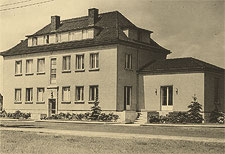
Designs and builds his own three-storey house with an art studio and picture gallery on the ground floor in the Spandau district of Berlin. Contributes several works to exhibitions at the Verein Berliner Künstler.
1936
Learns of the arrest of his brother Boris and the death of his mother in Russia. Ceases corresponding with his Russian relatives for fear of endangering their lives.
1938 - 1944
Member of the Inselgruppe -- a group of artists unable to engage in free creativity under the Nazis. Other members include Karl Hofer, Max Pechstein, Ernst Fritsch, Willy Jaeckel and Albert Klatt. The group is supported by Karl Weigelt, owner of a night club, where the members exhibit their works.
1942
Divorces Gertruda Galler.
1943
Attempts to save his relative Vasily Tokarev, who is arrested by the Gestapo in Riga. His attempts are unsuccessful and Vasily is executed.
1944
Campaigns to restore the Verein Berliner Künstler building on Lützowplatz, destroyed during an Allied bombing raid. A year later, the partially restored building is again bombed in an air raid. Marries his student Annemarie Hahn. This second marriage is unsuccessful and, in 1946, Annemarie moves to Australia, where she works all her life as a graphic artist.
1945 - 1948
Berlin is occupied by the Red Army and Sagrekow’s house becomes the Soviet military headquarters. Interprets for Soviet officers dealing with the local authorities. Commissioned to paint twelve portraits of Soviet generals, including Georgy Zhukov and Konstantin Rokossovsky. After the division of the city into East and West Berlin, finds himself in the Western sector. With the establishment of the Iron Curtain, loses touch with his homeland forever.
1948
Marries Rosi Duler. His third wife is the widow of the artist Bugle.
Late 1940s
Helps to restore the Verein Berliner Künstler on Lützowplatz.
1950
Elected deputy chairman of the Verein Berliner Künstler.
1952
Awarded German citizenship after living in Germany for thirty years.
1956
Unsuccessfully attempts to create a free school of the arts on Glockenturmstrasse.
1950s
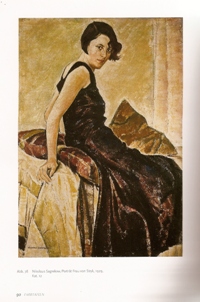
Works prolifically, painting landscapes, the outskirts of Berlin, still-lifes and portraits.
1960s
Becomes the principal architect of the Glockenturmstrasse district in Berlin, building around thirty houses.
1970s
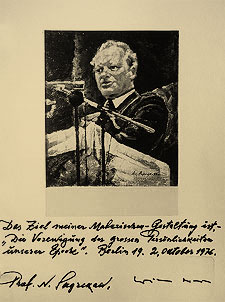
Returns to portrait painting. Paints portraits of his friend Kurt Roensch (1974) and Willy Brandt, leader of the Social Democratic Party and West German chancellor (1976).
1972
Exhibition of works celebrating the artist’s seventy-fifth birthday at the Spandau Board of Culture and the House of the East German Homeland. Presents a portrait of Friedrich Ebert, first president of the German republic, to the Social Democratic Party.
1973
Publication of his biography in Very Important Persons -- a list of eight hundred people who have made an important contribution to the economy, science, politics and culture of West Germany.
1976
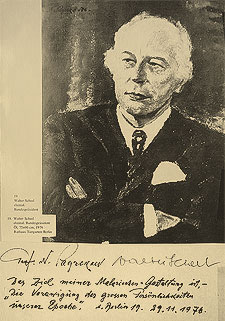
Paints a portrait of German federal president Walter Scheel, later acquired by the City of Berlin.
1979
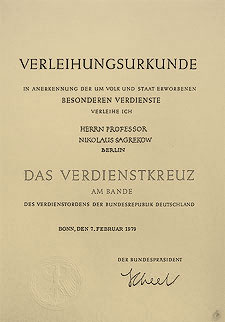
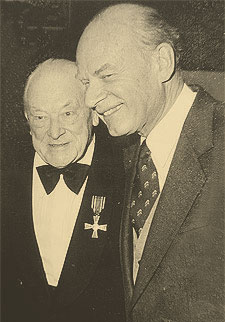
Receives the highest award of the Federal Republic of Germany for services to the country in the field of art. One-man show in Berlin. Elected an honorary member of the Accademia Italia delle Arti e del Lavoro and awarded a golden European medal for arts and culture. One-man show in Parma.
26 September 1980
Awarded a gold medal for his contributions to art and the preservation of culture by the Europäischer Kulturkreis Baden-Baden. Retrospective at the Verein Berliner Künstler.
March 1985
Exhibits sixty-nine of his most important works at a large one-man show in Berlin.
1986
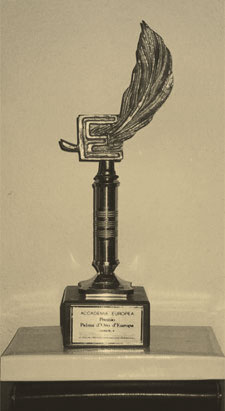
Awarded the Premio Palma d’Oro d’Europa Assegnato all’Artista by the Accademia Europa in Italy.
1991
Exhibits forty works at his last one-man show in Berlin.
13 July 1992
Dies at home not long after his ninety-fifth birthday.
1994
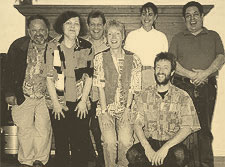
Nikolai-Sagrekow-Freundeskreis opens a museum at the artist’s house in Berlin.
2004
Shows of the artist’s works at the Tretyakov Gallery in Moscow and the Russian Museum in St Petersburg during a year of German culture in Russia.
2006
Reopening of the memorial museum after repair work.
|